
1. The pressure of MPP producing
The pressure in the injection molding process includes back pressure and injection pressure. When a screw injection molding machine is used, the pressure on the melt at the top of the screw when the screw rotates and retreats is called back pressure. Generally, an increase in back pressure will increase the temperature uniformity and mixing uniformity of the PE melt. Increasing the back pressure is also beneficial to exhaust the gas in the melt and increase the density of the melt, thereby increasing the injection volume of the machine. For PE raw materials, increasing the back pressure can increase the temperature, composition and color uniformity of the melt.
2. The temperature of MPP producing
The mpp electric conduit pipe is a thick-walled part. In order to avoid the internal stress caused by the excessive temperature difference during cooling, the temperature of the barrel should take a lower value. The temperature distribution of the barrel is generally from low to high temperature from the hopper to the nozzle, so that the plastic temperature rises steadily and achieves the purpose of uniform plasticization. To prevent the plastic from overheating, the temperature is slightly lower near the nozzle. The mold temperature has a great influence on the internal performance and appearance quality of the product. For the PE drainage pipe, in addition to the filling rate, the mold temperature will also directly affect the crystallinity and crystal configuration of the product. Therefore, the power mpp tube mold is suitable for medium mold temperature. For PE material, the cooling rate is suitable, the crystallinity of the plastic is moderate, and it has good physical and mechanical properties.
3. Grasp the time of MPP producing
In the entire molding cycle, injection time and cooling time have a decisive influence on the quality of the product.
In the production of MPP power tubes, the injection molding process is used to increase its efficiency and prolong its service life. Therefore, HAILI first considers pressure, temperature, and time, and pays attention to the selection of materials, to meet the standard production requirements.

What are the differences in the quality of MPP power tubes?
MPP power tube is an MPP power cable protection tube, and modified polypropylene is the main raw material of the MPP power tube. Compared with the traditional method of "digging trenches and burying pipes", trenchless electric conduit pipeline engineering is more suitable for current environmental protection requirements and eliminates the interference factors such as dust and traffic jams caused by traditional construction. The technology can also be used to lay pipelines in areas that cannot be excavated, such as historic site reserves, urban areas, crop and farmland reserves, highways, rivers, etc.
Resistant to high temperature and external pressure, suitable for 10kV high-voltage transmission lines and cables. 110m-250mm, divided into ordinary type and enhanced type. The ordinary type is suitable for excavation and laying construction and trenchless crossing construction projects with a buried depth of less than 4M. This type of reinforcement is suitable for projects with a buried depth greater than 4M for trenchless crossing construction.
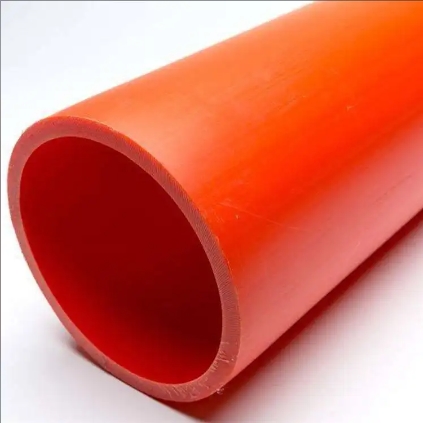
(1) Material characteristics: MPP power tubes are mainly made of MPP-C resin with excellent heat resistance and insulation properties. MPP products are currently recognized green products, and their excellent physical and chemical properties are increasingly being valued by the industry. MPP electric conduit pipe is a hard straight solid wall pipe, the inner and outer walls are smooth and flat, the color is orange-red, and the color is bright and eye-catching.
(2) Heat resistance: The heat resistance temperature of the power MPP pipe is 15 °C higher than that of the ordinary UMPP double-wall corrugated pipe. The larger the inner diameter required. When the cable crosses special sections such as roads, bridges, and river channels, pipes with higher stiffness levels should be used. MPP electric conduit pipes used in special environments such as chemical plants and power plants should choose pipes with high ring stiffness. For cables used under sidewalks, residential areas, corporate buildings, and other places, electric conduit pipes with smaller ring stiffness can be used according to actual conditions to save costs. During the construction of the MPP electric conduit pipe, the trenching operation should be carried out according to the construction requirements, the bottom of the trench should be leveled and compacted, and then cement mortar should be used for leveling.


916.webp)
204.webp)
659.webp)
185.webp)
312.webp)
849.webp)
587.webp)
767.webp)